Many shipping companies have been avoiding the Red Sea for years because of the danger of attacks by the Houthis. The attack on the Dutch ship Minervue shows that this fear is justified. According to experts, commercial ships cannot start much against such an attack.
A week ago, the Minervagracht escaped an attack in the nick of time during the passage through the Gulf of Aden, which is an extension of the Red Sea. But Monday it was still hit. The ship was then near Djibouti. According to Rederij Spliethoff, the attack led to “considerable damage”. Two crew members were injured. Tuesday morning there was still a fire on the controlling ship.
The attack has not yet been claimed, but everything indicates the Houthis. The rebel group sometimes waits days before it claims responsibility. Michel Don Michaloliákos is also “the location and wise” of the attack of the Houthis. He is an analyst at the Haagsch Institute Geopolitieknu.
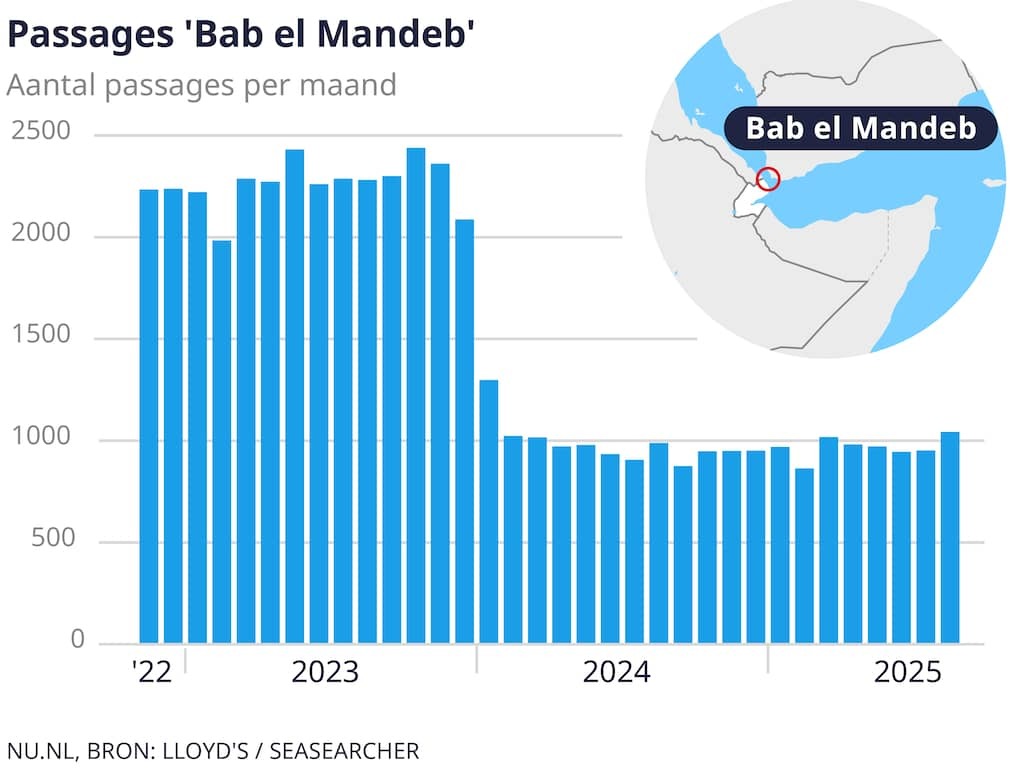
The attack on the minera grid does not come as a thunderbolt in clear sky. The problems for shipping traffic in the region started at the end of 2023. Then the Houthis hijacked the British-Japanese ship Galaxy Leader. One shipping company after the other then announced that they were no longer sailing through the dangerous passage. Since then, shipping traffic has never really recovered. Earlier, 12 percent of world trade went through the Zeestraat, which is the fastest route between Europe and Asia.
“Most ships under the Dutch flag are currently not sailing through the Gulf of Aden and the Red Sea,” says Cathelijne Bouwkamp of the Royal Association of Dutch Shipers (KVNR), which does not keep track of precise figures. The trend is also internationally visible. Before the end of 2023, an average of 72 to 75 ships passed Bab El Mandeb a day, where the Red Sea passes into the Gulf of Aden. This summer there were only 26 to 37 a day.
‘Every Sea Voyage is different, and so is the risk assessment’
The risk in the Red Sea forces shipping companies a difficult assessment. The alternative is sailing around the African continent. That amounts to 6,500 kilometers extra and a journey that lasts a week longer. It leads to higher costs and more emissions.
Rederij Spliethoff, who owns the Minervracht, does not want to say to Nu.nl at the moment why the Red Sea is still sailing. Spliethoff says he focuses full attention on the storage of the ship and securing the crew. Djibouti was a destination of the minervracht; So avoiding the entire region was possibly not an option.
The KVNR trade association also does not go into detail. “It is up to the shipowner to reject or accept an assignment against the weighted risks and conditions,” says Bouwkamp. “Every voyage is different and with that the risk assessment is different every time.”
According to analyst Michaloliákos, factors such as the departure port, the destination of the ship and the nature of the load play a role. Left with Israel are at least a red flag. With their attacks, the Houthis show solidarity with the Palestinians in Gaza.
The Effect of International Missions is Limited
International missions in the region, such as the European Aspides Operation, try to improve the safety for ships. But the effect of this is very limited, says Friso Dubbelboer. He is a researcher at Leidenasiacentre. “Such a mission can protect ships in the immediate vicinity, but are not everywhere at the same time. The sea is large and the number of ships is limited.”
He is not surprised that the Americans bombed Houthi goals earlier this year, “to tackle the problem at the source”. That attack ended with a ceasefire, where the Houthis promised not to attack American ships anymore. That seems to the disadvantage of European ships. In July the Houthis brought the Eternity C and Magic Seas to sink. Both ships had a Greek owner.
After those attacks, the insurance premium for ships that still want to sail through the Zeestraat, writes Marineinsight . In the meantime it costs between 0.7 and 1 percent of the value of the ship and the load to take out insurance. Some companies simply refuse to insure ships that sail through the region.
Little Can Be Done Against Drones
According to Dubbelboer, commercial ships can do little if they are attacked. “They can double the guard at most and turn on all the lights,” he says. “And to prevent enter attempts, they sometimes hang fire hoses over the places where it is easy to climb on board.” But that especially applies in the fight against piracy. The ships are even more vulnerable when using drones.
According to Michaloliákos, the Houthis will continue to attack ships for the time being. With this, the group wants to show that it is still relevant, after patron Iran is weakened by Israeli and American attacks. “The Houthis are now dependent on themselves and they want to show that they can still do great damage.”
He advises Europe to increase the military presence in the Red Sea and the Gulf of Aden. He also argues for focusing on multiple trade routes. According to him, the so-called Imec route, which via India is partly over land and partly by sea to Europe, can be an alternative. In the future, the Pool Route could also become an alternative, if the Northern Ice Sea is more free to climate due to a warmer climate.